ABC Rummy Education
Rummy is one of the most established card games in India, widely appreciated for its balance between entertainment and skill-based decision-making. Unlike games that depend purely on chance, rummy rewards players who can observe patterns, plan ahead, and make logical choices under changing conditions.
On platforms such as ABC Rummy, the game is presented in a structured digital format where players can learn gradually, starting from basic rules and moving toward more advanced strategic thinking. This educational approach is especially important for beginners who are still adapting to online gameplay environments.
At its core, rummy is about forming valid combinations of cards. These combinations are called sequences and sets, and the entire gameplay revolves around building them faster than your opponents. However, understanding rummy properly requires more than just memorizing rules. It involves learning how probability works, how opponents behave, and how each decision affects the outcome of the round.
When players first enter the platform, they usually go through a simple onboarding flow. They create an account through Sign Up, access their dashboard using Login, and often receive a Bonus that helps them start playing with extra balance or trial opportunities. Some users prefer installing the APK version for smoother mobile performance, especially in regions where mobile gaming is dominant. From there, they explore different Games Links available inside the lobby, each offering slightly different formats or entry levels.
Understanding these elements early helps players avoid confusion later, especially when transitioning from casual learning to real matches.
Understanding the Structure of Rummy
Rummy is built on a clear structure that repeats in every game round. Cards are distributed to all players, and each player tries to arrange them into meaningful groups. The key challenge is not just forming combinations, but doing it efficiently before opponents complete their hands.
One of the most important concepts in early learning is recognizing how different card types interact. Some cards are more flexible, especially when jokers are involved, while others require careful placement in sequences. This is where beginner mistakes often happen—players tend to focus on individual cards instead of thinking about long-term combinations.
To make this clearer, here is a structured breakdown of the main gameplay components.
Core Rummy Learning Structure
| Concept | Meaning | Why It Matters |
|---|---|---|
| Sequences | Consecutive cards arranged in order of the same suit | Essential for forming a valid declaration |
| Sets | Cards of the same rank but different suits | Helps reduce total points in hand |
| Jokers | Substitute cards used to complete combinations | Speeds up completion of difficult sequences |
| Discard Strategy | Choosing which card to throw away each turn | Directly influences opponent’s advantage |
How Beginners Should Think About the Game
At the early stage, most players focus too much on individual moves. However, rummy is not about isolated decisions—it is about patterns over time. Every card you pick or discard changes the direction of the game. This means that even a small decision in the first few rounds can affect your chances of winning much later.
A strong beginner mindset is built around patience. Instead of rushing to complete combinations, players should observe what cards are being discarded, what might be missing in their hand, and how quickly the game is progressing. This awareness builds the foundation for more advanced strategies later.
On ABC Rummy, this learning curve is especially important because online gameplay is faster than traditional physical card games. Decisions must be made quickly, but still logically.
Why Early Learning Matters
Many players underestimate the importance of the learning phase. They jump directly into gameplay without understanding structure, which often leads to repeated mistakes. Learning rummy properly ensures that players develop consistency instead of relying on luck.
The educational foundation also helps players avoid emotional decision-making. When players understand how the game works, they are less likely to make random or impulsive moves. Instead, they begin to think in terms of probability and long-term outcomes.
How Gameplay Actually Evolves
Every round in rummy follows a repeating cycle: draw, evaluate, and discard. However, within this cycle, there is constant decision pressure. The player must decide whether to pick from the open pile or the closed deck, whether to hold onto a card for a potential sequence, or whether to discard it immediately to reduce risk.
What makes online gameplay on ABC Rummy particularly interesting is speed. Decisions are time-limited, which forces players to rely on instinct built from experience rather than overthinking every move.
As players gain experience, they start recognizing patterns in opponents’ behavior. For example, repeated discards of a certain suit may indicate that a player is not collecting that sequence. Similarly, sudden changes in discard behavior can suggest that a player is close to declaring.
Decision Factors in Gameplay
| Decision Point | What Player Considers | Impact on Game |
|---|---|---|
| Card Selection | Whether to pick from open or closed pile | Can accelerate or slow down progress |
| Discard Choice | Which card reduces risk without helping opponents | Directly influences opponent strategy |
| Holding Strategy | Deciding whether to keep risky cards | Affects long-term winning probability |
| Declaration Timing | When to finish the game | Critical for final victory or loss |
Understanding Opponent Behavior
A major shift in thinking happens when players stop focusing only on their own hand and begin analyzing opponents. Even though cards are hidden, patterns in movement reveal partial information. For example, if a player consistently avoids certain suits, it may indicate they are building around a different structure.
This is where rummy becomes more psychological. It is no longer just a card arrangement game—it becomes a reading game. Skilled players use small clues to estimate what others are building and adjust their strategy accordingly.
On ABC Rummy, this layer of competition becomes more noticeable because players are matched in real-time environments where experience levels vary.
Strategy vs Outcome Influence
Why Strategy Matters More Than Luck
Although luck determines the initial distribution of cards, it does not decide the outcome. Over multiple rounds, strategic players consistently outperform those who rely on chance. This is because strategy reduces randomness over time by making decisions more efficient.
Timing also plays a critical role. Knowing when to hold back and when to act aggressively often separates average players from strong ones. Similarly, observation skills help players anticipate future moves and reduce uncertainty.
As players progress, they begin to experience a psychological layer in the game. This includes predicting opponents, hiding intentions, and making misleading moves to confuse others. Even simple actions like discarding a certain card can be used strategically to mislead opponents.
This makes rummy on platforms like ABC Rummy not just a card game, but a mental exercise that combines logic and behavior analysis.
Understanding Probability in Rummy
Probability in rummy is not complex mathematics—it is practical thinking. For example, if many cards of a certain rank or suit have already been discarded, the chances of completing a sequence using those cards decrease significantly. On the other hand, if few cards have appeared on the table, the probability remains higher.
This is why experienced players constantly observe the discard pile. It acts like a memory tool that reveals hidden information about the remaining deck.
Another important idea is flexibility. Some cards are more useful because they can fit into multiple potential sequences. These cards increase your probability of forming a valid combination, while rigid cards reduce flexibility and increase risk.
Risk Control as a Core Skill
Risk control in rummy is about reducing uncertainty over time. Players do this by avoiding unnecessary high-value cards that are difficult to use in sequences. Holding such cards too long increases penalty points if the opponent declares first.
Good risk management is not about playing safely all the time—it is about balancing safety with opportunity. Sometimes taking a calculated risk can speed up completion, but it should always be based on observation rather than guesswork.
On ABC Rummy, this becomes especially important because fast gameplay reduces thinking time, so decisions must be pre-trained through experience.
Probability & Risk Behavior
| Factor | What It Means | Effect on Gameplay |
|---|---|---|
| Card Availability | How many useful cards remain in the deck | Higher availability increases success chance |
| Discard Tracking | Monitoring opponent and table discards | Reduces uncertainty and improves prediction |
| Hand Flexibility | Ability of cards to fit multiple sequences | Increases probability of quick completion |
| Risk Exposure | Value of ungrouped or high-point cards | Higher exposure increases penalty risk |
How Experienced Players Think Differently
Beginners often focus on immediate moves, while experienced players think several steps ahead. They mentally simulate how the game might develop based on current information. This includes imagining possible card combinations that opponents might be building.
Instead of reacting to each turn individually, they build a broader picture of probability. This allows them to avoid unnecessary risks and make more stable decisions over time.
This difference in thinking is what separates casual players from consistent winners on platforms like ABC Rummy.
Risk Distribution in Gameplay
Interpreting Risk Behavior
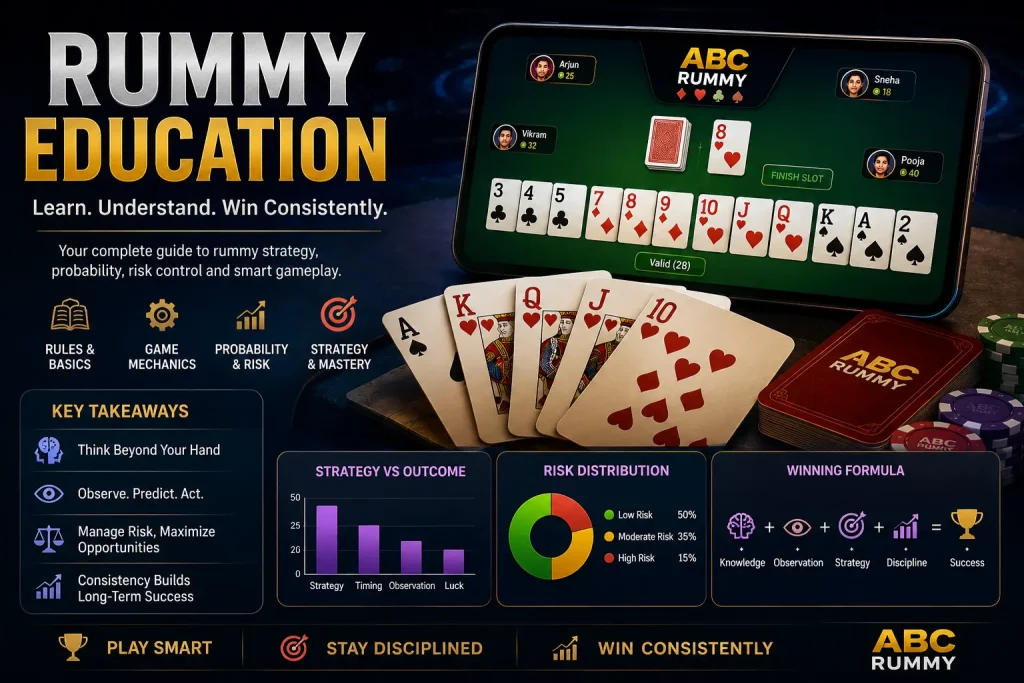
The chart shows that most successful gameplay relies on low-risk decisions. Moderate-risk moves are used strategically when the potential reward justifies the uncertainty. High-risk moves are used rarely and only when the situation demands fast completion.
This balance is important because rummy is not about avoiding risk completely—it is about managing it intelligently.
Players who consistently take uncontrolled risks tend to lose over time, even if they occasionally win big rounds. In contrast, controlled players build steady long-term performance.
Psychological Side of Probability
Probability also affects decision psychology. When players feel uncertain, they often overestimate risk or underestimate opportunity. This emotional bias can lead to poor decisions.
Training yourself to think in terms of probability rather than emotion helps reduce these mistakes. Instead of reacting to fear or excitement, players begin to rely on structured reasoning.
On ABC Rummy, this psychological control becomes a major advantage due to fast gameplay pressure.
How Real Gameplay Feels at Advanced Level
In real matches, decisions are made in seconds. There is no time for overthinking. A player must quickly decide whether a card is useful for a future sequence or whether it should be discarded immediately to reduce exposure.
Players are constantly scanning discarded cards, tracking possible combinations, and adjusting their strategy without conscious effort. This is what separates casual play from structured mastery.
On ABC Rummy, this experience becomes even more noticeable because the gameplay environment is fast, competitive, and based on continuous decision flow rather than slow analysis.
Responsible Play as a Core Discipline
One of the most overlooked aspects of advanced gameplay is discipline. Even highly skilled players lose control when they become emotionally involved in a session. This usually leads to rushed decisions, unnecessary risks, and inconsistent outcomes.
Responsible play is not a rule—it is a mindset. It means knowing when to continue and when to stop, without letting emotions interfere. It also means treating each round as part of a larger pattern, not as an isolated opportunity to recover losses or chase wins.
Players who maintain discipline tend to perform more steadily over time, even if they do not always win individual rounds.
Responsible & Structured Play Framework
| Element | What Happens in Practice | Result |
|---|---|---|
| Controlled Thinking | Decisions are made based on logic, not emotion | Fewer mistakes during fast rounds |
| Time Awareness | Player avoids rushing moves under pressure | More stable game outcomes |
| Risk Balance | High-risk moves used only when necessary | Lower long-term losses |
| Focus Management | Attention stays on full table, not just own cards | Better prediction of opponents |
What Separates Average Players from Consistent Winners
The difference is not in knowledge of rules—it is in execution under pressure. Many players understand how rummy works but still make inconsistent decisions because they react emotionally to outcomes.
Advanced players do not change strategy after a single loss. They treat results as part of a larger pattern. This allows them to stay stable even during losing streaks and avoid overreaction.
On platforms like ABC Rummy, this stability is what creates long-term consistency.
Rummy is best understood as a structured skill game where every round is shaped by a combination of logic, timing, and awareness. From the very beginning, players learn how to form sequences and sets, but true improvement happens when they start thinking beyond individual moves and begin to see the full flow of the game.
As experience grows, the focus naturally shifts from rules to decisions. What to pick, what to discard, and when to act become more important than simply knowing combinations. Each choice carries meaning, and even small decisions can influence the outcome of an entire round.
On platforms like ABC Rummy, this progression becomes especially clear because gameplay is fast, competitive, and continuous. Players quickly realize that success is not about isolated wins, but about maintaining consistency across many rounds.
Understanding probability and risk helps reduce uncertainty, while observation builds the ability to read the game beyond your own hand. At the same time, emotional control ensures that decisions stay stable even under pressure. When these elements work together, gameplay becomes more predictable and controlled over time.
Ultimately, rummy rewards patience, discipline, and structured thinking. Players who take time to understand the system behind the game gradually develop stronger performance and more stable results.
Frequently Asked Questions
What is the main goal in rummy?
The main goal is to form valid sequences and sets before opponents. A valid declaration requires at least one pure sequence, and the rest of the hand must be organized into logical combinations. Success depends on speed, structure, and smart decision-making rather than random card collection.
Is rummy a game of luck or skill?
Rummy is primarily a skill-based game. While initial card distribution involves chance, long-term results depend on strategy, probability understanding, and opponent observation. Skilled players consistently outperform less experienced ones over time.
How important is observation in gameplay?
Observation is critical. Tracking discarded cards helps players understand what combinations opponents are building. This allows better predictions and reduces unnecessary risks during gameplay.
Can beginners win regularly?
Beginners can win rounds, but consistent success requires practice and understanding of strategy. Over time, learning probability, risk control, and timing improves overall performance significantly.
What is the most important skill in rummy?
The most important skill is decision-making under uncertainty. Players must quickly evaluate whether to keep, discard, or pick a card while considering both their own hand and possible opponent strategies.