
ABC Rummy 3 is a variation built around fast gameplay cycles and short decision loops, where players operate under constant tempo pressure. At the same time, access to the platform is not always stable, which introduces an additional layer to the experience — the need for reliable entry points.
Because of this, ABC Rummy 3 is not only about gameplay efficiency but also about access continuity through mirrors, alternative links, and mobile entry options.
Access Layer in ABC Rummy 3
Unlike standard pages that only describe gameplay, this format requires understanding how players actually enter the system. Access becomes part of the overall structure.
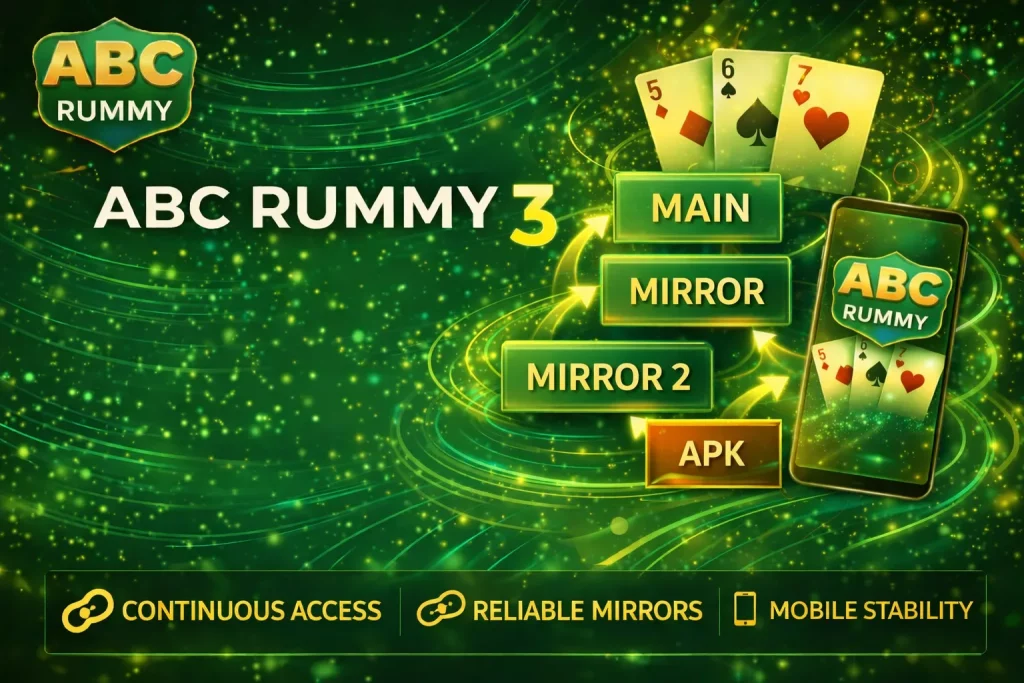
Players interact with the platform through:
- main domain access
- mirror links
- mobile browser versions
- APK-based entry
Each option affects how consistently gameplay can be maintained.
Core Concept: Micro-Decision + Continuous Access
The gameplay itself is based on micro-decisions, but these decisions only matter if the player maintains uninterrupted access.
This creates a dual-layer system:
- gameplay layer → fast decisions and reactions
- access layer → stability through links
If access breaks, gameplay continuity is lost.
Access Interaction Table
Why Access Stability Matters
ABC Rummy 3 is built on fast decision cycles. Any interruption — even a short one — breaks the rhythm of gameplay.
This leads to:
- loss of tempo
- broken decision flow
- reduced efficiency
Stable access ensures uninterrupted decision cycles.
Player Behavior and Mirror Usage
Players naturally adapt their behavior based on access conditions.
When the main domain is stable:
- direct access is preferred
When access becomes unstable:
- mirror links are used
- alternative entry points become primary
This creates a dynamic access pattern.
Early Phase: Entry Optimization
At the beginning, players are not only adapting to gameplay but also selecting the most stable access point.
This includes:
- testing main link performance
- switching to mirrors if needed
- ensuring stable connection before play
This step determines session quality.
Mid-Session Stability
Once gameplay begins, stability becomes critical.
Players aim to:
- avoid reconnections
- maintain session continuity
- prevent disruptions
Mirror links play a key role here.
Access vs Gameplay Speed
A key relationship exists between access stability and gameplay speed.
Stable access:
- supports fast decisions
- maintains rhythm
Unstable access:
- slows down reaction time
- increases error rate
This directly affects performance.
Interaction With Platform Structure
Players do not interact with gameplay alone — they interact with the platform environment.
This includes:
- switching links
- adjusting access method
- maintaining connection
This adds an external layer to gameplay.
Micro-Decision Flow
Within stable access, gameplay follows rapid cycles:
- card selection
- sequence adjustment
- discard
Each cycle depends on uninterrupted flow.
Structural Observation
ABC Rummy 3 operates as a system where gameplay speed depends on access stability.
Players must manage:
- fast decision cycles
- stable entry points
- continuous session flow
ABC Rummy 3 becomes more complex when access is no longer treated as a static entry point but as a variable that directly influences gameplay efficiency. At this stage, players begin to optimize not only their decisions in-game but also how they maintain stable access throughout the session.
Access Efficiency in Gameplay
Access efficiency reflects how reliably a player can maintain connection to the platform without interruptions. Since ABC Rummy 3 is built around rapid decision cycles, even minor delays or disconnections affect overall performance.
Efficient access occurs when:
- connection remains stable throughout the session
- switching between links is minimized
- entry points are optimized before gameplay begins
This creates a system where access is part of performance.
Main Link vs Mirror Stability
The main domain is designed for direct access, but it is not always the most stable option. Mirror links, while secondary, often provide more consistent availability.
Main link:
- fastest initial connection
- moderate reliability
Mirror links:
- slightly delayed initial access
- higher long-term stability
Players must choose based on conditions.
Access Distribution Over Time
The chart shows how reliance shifts from the main domain to mirror links as the session progresses. Stability becomes more important than initial speed.
Timing and Access Switching
Switching between links during gameplay is one of the main causes of disruption. Players must decide when to switch access points.
Effective timing includes:
- switching before gameplay begins
- avoiding mid-session changes
- selecting the most stable option early
This reduces interruptions.
Access Efficiency Mapping Table
Why Access Interruptions Affect Performance
ABC Rummy 3 requires constant decision flow. Interruptions break this flow and reduce efficiency.
Consequences include:
- loss of rhythm
- delayed reactions
- increased error rate
Players must avoid unstable connections.
Pre-Session Optimization
Experienced players prepare access before starting gameplay.
This includes:
- testing connection speed
- checking mirror availability
- selecting the most stable entry
Preparation improves performance.
Interaction Between Access and Gameplay
Access is not separate from gameplay — it directly affects it.
Players must:
- maintain stable connection
- avoid switching links during play
- align access method with session length
This creates a unified system.
Adaptive Access Behavior
Players adapt their access strategy based on conditions.
They:
- switch to mirrors when needed
- use APK for long sessions
- rely on browser for quick access
Flexibility improves stability.
Efficiency vs Convenience
Convenience does not always equal efficiency.
Main link:
- easy to use
- not always stable
Mirror / APK:
- require extra step
- provide better performance
Players must prioritize efficiency.
Behavioral Observation
At this stage, players no longer treat access as a one-time action. Instead, they manage it as part of their gameplay strategy, ensuring stability before focusing on decision-making.
ABC Rummy 3 reaches its most stable and efficient form when access management becomes structured rather than reactive. At this stage, players no longer depend on a single entry point but operate within a system of alternative links, ensuring continuous gameplay regardless of external limitations.
Access Architecture in Gameplay
Access in ABC Rummy 3 can be viewed as a layered system where each entry method plays a specific role. Instead of relying on one connection path, players distribute access across multiple channels.
This architecture is built on:
- primary access (main domain)
- secondary access (mirror links)
- fallback access (APK or mobile version)
Each layer supports continuity.
From Single Entry to Multi-Channel Access
Earlier stages focus on entering the platform successfully. At this stage, the focus shifts toward maintaining access under any condition.
Players begin to:
- prepare multiple working links
- switch access methods strategically
- avoid dependency on one domain
This reduces risk.
Access Layers Table
Maintaining Continuous Access
Continuous gameplay requires uninterrupted connection. Players must prevent disruptions before they occur.
This includes:
- avoiding unstable links
- selecting mirrors for longer sessions
- using fallback options when needed
Continuity supports performance.
Predictive Access Strategy
Advanced players anticipate access issues rather than reacting to them.
They:
- keep alternative links ready
- monitor connection stability
- prepare backup access methods
This reduces downtime.
Stability vs Speed in Access
A balance exists between fast access and stable access.
Fast access:
- achieved through main domain
- may be less reliable
Stable access:
- achieved through mirrors or APK
- ensures long sessions
Players must choose based on session type.
Error Prevention in Access
Access-related issues often come from poor preparation.
Common problems include:
- relying on a single link
- switching access mid-session
- ignoring backup options
Preventing these improves stability.
Interaction Between Access and Gameplay
Access directly affects gameplay quality.
Stable access:
- supports fast decision cycles
- maintains rhythm
Unstable access:
- interrupts flow
- increases mistakes
Players must align access with gameplay needs.
Multi-Session Adaptation
Players adjust access strategies across different sessions.
Short sessions:
- main link is sufficient
Long sessions:
- mirrors or APK preferred
This improves efficiency.
Access Flow Control
At this stage, access is managed as a continuous flow rather than a fixed point.
Players:
- monitor connection quality
- adjust entry methods
- maintain stable channels
This creates a dynamic system.
Interaction Depth
Access management becomes part of overall gameplay strategy.
Each decision includes:
- how to play
- where to play
- how to maintain connection
This adds an additional layer to the experience.
Structural Outcome
ABC Rummy 3 rewards players who can maintain both gameplay efficiency and access stability.
Strong players:
- use multiple access channels
- prioritize stability over convenience
- maintain continuous gameplay flow